Published
Doing deep research across a full book of target accounts is hard.
Most reps just don't have the time.
This blog covers what an account research agent is, how Duo Accounts combines your first-party data with the public web to research every account you own, and what changes for account-based selling when the research is done for you.
What is an account research agent?
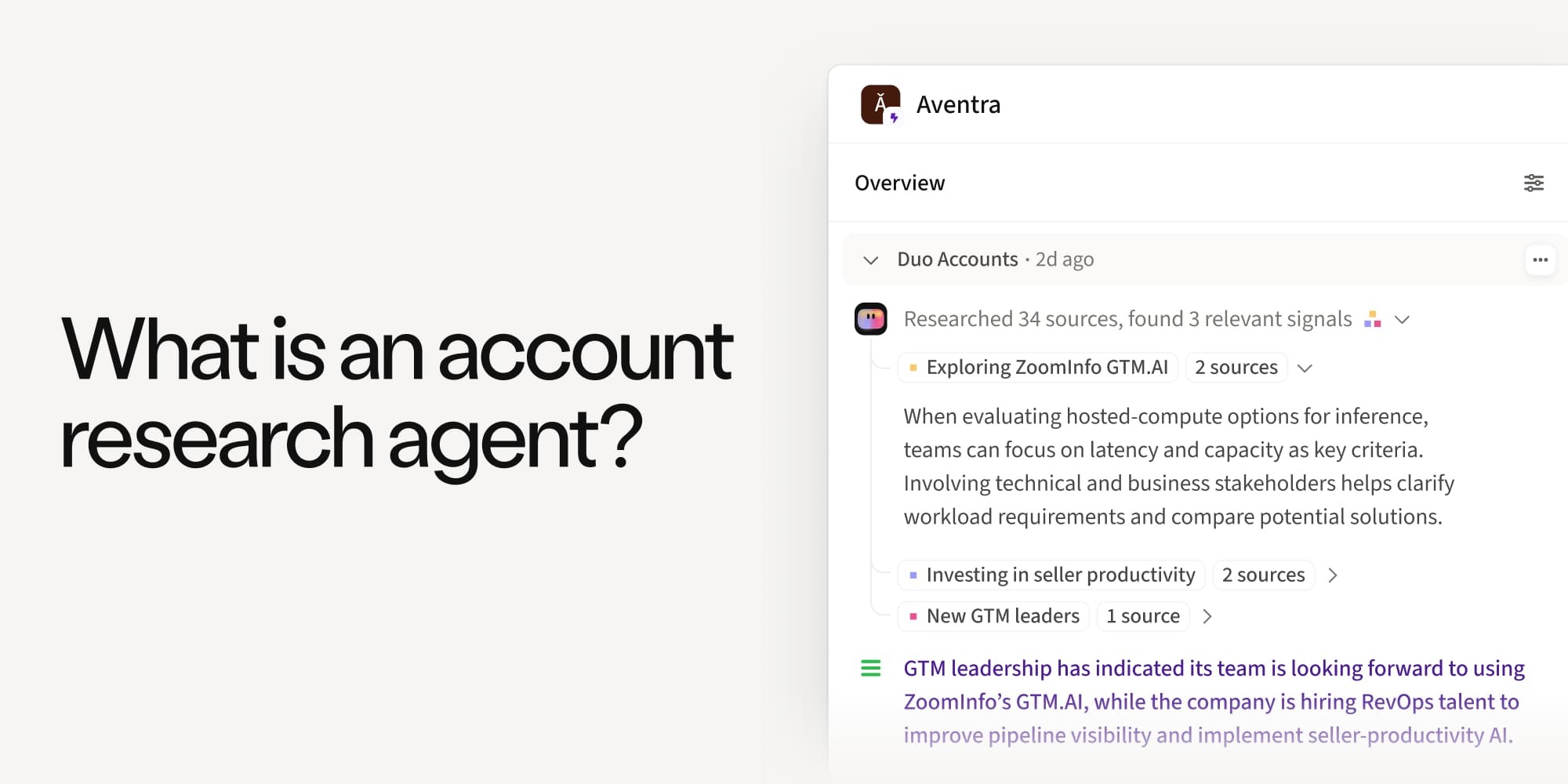
An account research agent is an AI that researches a target account for you and reports back what it found, so a rep does not have to do the research by hand. You name the account, the agent goes through the available sources, and you get a summary: what the company is doing, what has changed recently, and anything that looks like a reason to reach out.
In its simplest form, that is a research report on a company, built from the public web, produced when you ask for it. It saves the manual work of gathering information across browser tabs, but it does not tell you which of your two hundred accounts to open first, whether the reason it was found is strong or weak, or what to do next.
Duo Accounts is Amplemarket's account research agent, and it is built to close that gap.
- It combines your first-party data, the activity and notes in your CRM and your Duo signals, with the public web, so it finds reasons the public web alone can't show. That combination is the difference.
- It researches the accounts you choose to track, giving your team a consistent view across its target list.
- It returns reasons to engage rather than a summary, with the signals behind each reason and the source behind each signal, so you can check its work.
- It gives every tracked account a relevancy level - high, medium, low, or none - so the whole list can be sorted, and the accounts with nothing on them say so.
- It refreshes research on a regular schedule, so your team can revisit accounts as new reasons to engage appear.
And it connects research to action: use Plan outreach with your AI assistant, review the recommendations, then act right in Amplemarket through MCP.
How is an account research agent different from sales intelligence and intent data?
Sales intelligence and intent data are useful inputs to account research. Capabilities vary by product; the account research column below shows the workflow Duo Accounts supports.
An account research agent sits on top of both: it takes company data and signals as inputs and turns them into a reason, a person, and a next step.
Amplemarket now has Duo Accounts
Duo Accounts is Amplemarket's account research agent, built for account-based sales and marketing teams: ABM teams and reps who own a book of business and a pipeline target.
It is part of the Duo suite, which means it runs on Duo Intelligence, the intelligence layer behind Amplemarket's advanced features.
How Duo Accounts researches an account, step by step
Two things happen on every account you track.
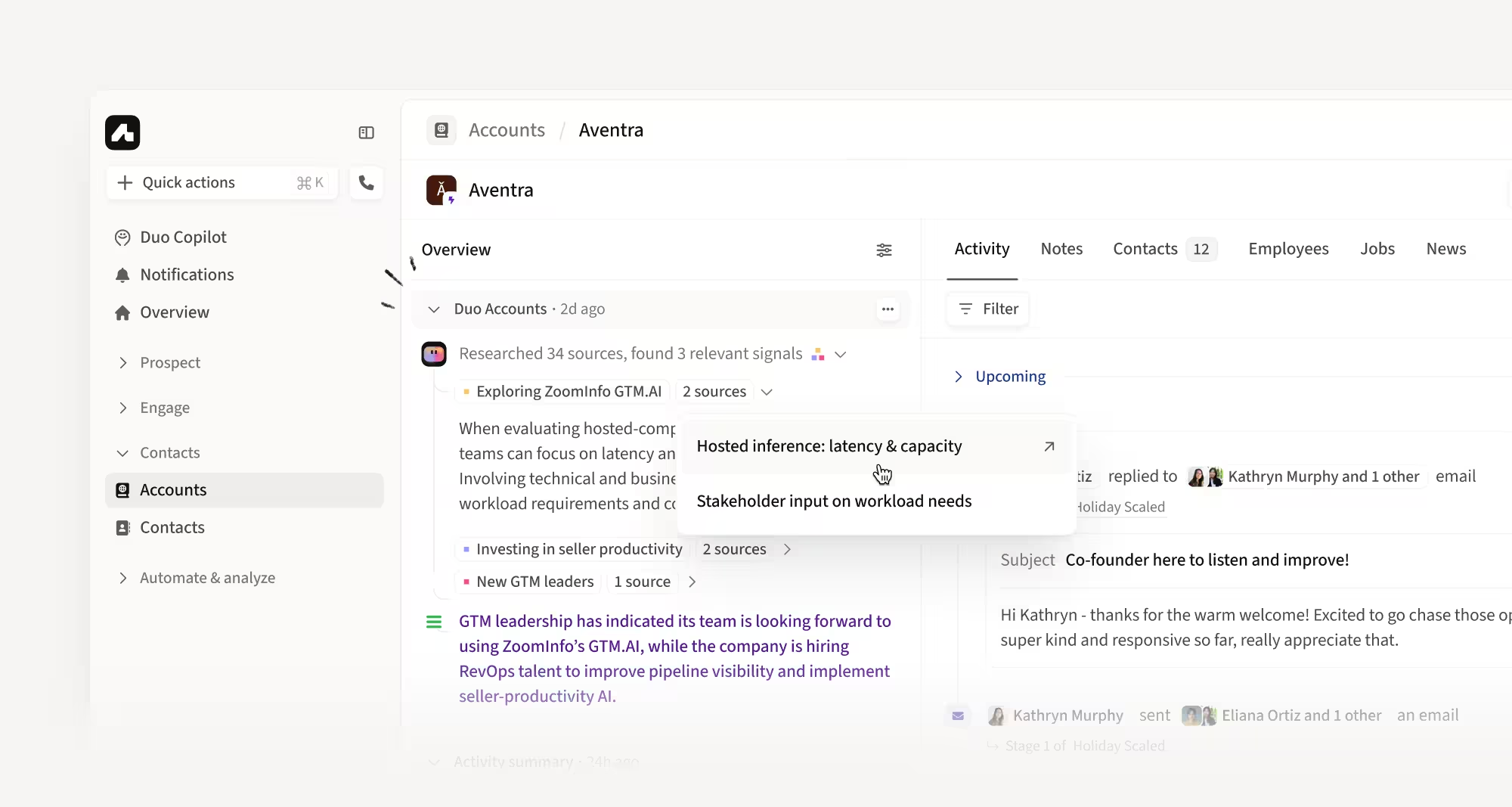
1. Research agents do the gathering. They combine your CRM activity and notes with all of your past interactions, Duo signals and Amplemarket's own company data. Then they go to the public web: news, job openings, social activity, reviews, and the company's own blog and web pages. Everything they find comes back as a signal tied to its source, and the research on each account shows which sources were checked.
2. Duo Intelligence does the thinking. It reads the signals together, writes the reasons to engage, assigns the relevancy level, and keeps the brief current as the agents keep researching.
What you see is Duo Accounts' summary, with every finding one click away: each reason opens to its signals, and each signal opens to its source. That is deliberate: the work is shown so a rep can check a reason before acting on it, rather than taking it on trust.
What a reason to engage looks like
An account is posting for a sales development representative and two account executives.
- Separately, the company's head of talent writes a post about growing the sales team.
- Separately again, a new sales development director has just started, and the CRM shows outbound is still run out of the CRM alone.
Each of those is a small fact.
Read together, they suggest the account is expanding its outbound motion. The new sales development director could be a useful first contact.
Duo connects the signals into a reason to engage and attaches the sources, so the rep can check the reasoning before acting.
That is the difference between a signal and a reason. A signal is one fact; a reason connects all the known facts to a problem your product can help solve. The same research can support different conversations: ramping the team with a sales leader, and data quality and workflows with RevOps. Plan outreach helps turn those angles into a multithreaded plan.
What happens when there is nothing to find
Duo Accounts says so. When the research finds no relevant reason to engage, the account gets a relevancy level of none, not a padded list of weak reasons.
That helps you judge timing without confusing a lack of fresh signals with a lack of strategic account fit.
What should a sales team do after a buying signal appears in a target account?
A buying signal on its own is not a reason to send anything. It is a prompt to find out what is going on.
A practical way to turn signals into relevant conversations is to follow six steps:
1. Verify the signal. Check that it is real, current, and about the account you think it is. A job post that closed last quarter or a news item about a namesake company is noise.
2. Read it with everything else you know about the account. One signal rarely means much. The same signal next to two others, or next to a note from a call your colleague had last year, usually does.
3. Decide how strong the reason is. Not every real signal deserves a sequence today. Some accounts have a clear, current reason to engage; some have a weak one; some have none. The decision about where to spend the week depends on telling them apart.
4. Find the person who owns the problem the signal points at. A hiring wave points at the leader doing the hiring. A new product launch points at whoever has to sell it. The signal usually names the first thread.
5. Build out from the first thread. Enterprise accounts are bought by committees. Once you know who owns the problem, map the people around them before the first touch, so the outreach is multithreaded from day one.
6. Act while the reason is fresh. Review the timing and messaging, then coordinate outreach while the account context is still relevant.
Duo Accounts supports the first four steps with research, source-backed reasons, and a relevancy level. The rep checks the findings; Plan outreach uses the AI assistant to recommend stakeholders, role-specific angles, and next steps.
From signals to action
Research only matters if it leads somewhere. Duo Accounts connects the signals on an account into a reason to engage, and then connects that reason to the actions that follow, in the same place.
From an account's brief, "Plan outreach" hands the full account context and the research to your AI assistant, such as Claude or ChatGPT, which recommends who to engage, which angles to lead with, and an outreach plan.
Review the recommended stakeholders, angles, and outreach plan, then act in Amplemarket through MCP: add contacts to a sequence with messaging tailored to each role, create follow-up tasks, and save useful angles as account notes. The research stays connected to the work that follows.
The same connection works in the other direction: connect Claude or ChatGPT through the MCP, and you can ask questions across your whole book, such as which accounts are rated high relevance but haven't been contacted in sixty days, and act on the answer.

What teams use Duo Accounts for
1. Working a large book in the right order.
A rep with several hundred tracked accounts doesn't have to decide in advance which one to focus on. Open the list sorted by relevancy and start from the top: accounts with a strong, current reason to engage first, then medium.
The research surfaces things that would take a long time to find account by account, so prioritisation goes deeper than a rep could do alone.
2. Knowing what to focus on.
Start with accounts that have a strong, current reason to engage, then weigh the rest against strategic fit and what your team already knows. A low or no relevancy level does not mean an account is a poor fit. Research refreshes regularly, so a new reason will appear later.
Use relevancy to guide timing and prioritization alongside your account strategy.

3. Coordinating sales and marketing around the same account.
Shared research gives sales and marketing the same account context. Marketing can use it to shape account-specific messaging, content, and campaigns; sales can tailor outreach to different stakeholders. Live sequences, booked meetings, and teammates' notes help the team coordinate its next move around existing conversations.
"This is exactly the tool I've been wanting. It's basically like an intent dashboard. I can see what's happening across my accounts, find the right people, and get them into a sequence without leaving the flow."- Ivana Dulanto, Business Development Representative at Omni
Account research inside a sales engagement platform vs on the side
Account-based selling needs both a reason to engage and a way to act on it.
When research lives in browser tabs, a spreadsheet, or a separate report, the team has to carry that context into its outreach. Connecting research and engagement keeps the evidence close to the next action.
Do you need a separate research tool if you use a sales engagement platform?
Not if the research happens where the outreach happens.
A research tool on the side gives you a report you still have to interpret and carry across.
A platform without account research gives you the send and leaves the why to you.
Duo Accounts connects account research with execution in Amplemarket, with a connected AI assistant helping you plan the outreach.
"Duo Accounts surfaces insights that would've taken me a long time to find on my own. It's the kind of account research you know you should be doing but rarely have time for. Now it's all right there, making it easier to understand which accounts are worth prioritizing."- Reuben Tang, Senior Enterprise Business Development Representative at Rocketlane
How Duo Accounts fits with Duo Copilot and Account Insights
Amplemarket already shows you two other things about an account. Here is how the three relate.
- Duo Accounts answers these questions for the accounts you track.
- Duo Copilot works from the other direction, watching signals and surfacing people worth contacting wherever they are, inside your book or outside it.
- Account Insights tells you where the relationship stands once you're in.
For an ABM team, Duo Accounts is the starting point; the other two run alongside it.
Getting started
Contact your Amplemarket CSM or Account Manager to know more about how you can enable Duo Accounts for your team.
If you are new to Amplemarket, start a free trial or request a demo.