Published
A twelve-person SDR team ran email-first outbound for six months starting with a reply rate of 1.7%.
→ Then they added phone and kept email as the lead channel (cheapest)
Reply rate: 2.1%.
→ Then they inverted the order: LinkedIn first (highest trust), email second, phone third
Reply rate: 8.4%.
Same tools, same reps, different architecture.
That gap is not about effort or volume, it's about channel hierarchy: the order in which you introduce yourself to a prospect.
The thesis is that most teams get it backwards, and the penalty is months of wasted pipeline.
That is what this playbook is for.
It covers why the hierarchy matters, how to set up each channel correctly, day-by-day sequences for three ICP types, the AI layer that makes multi-channel practical, and the metrics that separate teams generating pipeline from teams generating noise.
What is multichannel outbound?
Multichannel outbound is a sales prospecting approach that combines two or more communication channels (email, phone, LinkedIn, SMS, and others) into a coordinated sequence targeting the same prospect. Rather than sending emails in isolation, multichannel outbound uses each channel to build on the previous touch, increasing recognition and reply rates across the full sequence.
What channels should you use for B2B outbound in 2026?
The five most effective channels for B2B outbound in 2026 are email, LinkedIn, phone, SMS (for engaged prospects only), and AI voice messages.
- Email remains the workhorse for volume
- LinkedIn is the highest-trust channel for cold introductions
- Phone compresses cycles when a prospect has already engaged
- SMS and AI voice messages work best as later-stage touches for warm signals
What you will learn
Multichannel outbound does not mean “more channels.” It means the right channels in the right order.
Here is what the best-performing teams in 2026 understand:
- Channel order determines reply rates more than channel count. A three-channel sequence with LinkedIn-first architecture outperforms a four-channel sequence with email-first architecture.
The hierarchy is the strategy. - Deliverability improves when you spread volume. Distributing touches across email, LinkedIn, and phone keeps per-channel volume below spam thresholds and protects sender reputation. Tiffany Wong at Pry Financials reported “>70% open rate consistently” partly because multichannel distribution keeps email volume disciplined.
- AI makes multichannel practical, not just theoretical. A rep managing 200 prospects across 4 channels would need 30-50 actions per day. AI handles account research, per-channel message generation, adaptive sequencing, and timing: turning a staffing problem into a configuration decision.
- Cross-channel metrics reveal what single-channel metrics hide. Track pipeline and revenue back to the full sequence, not individual emails or calls. A cold call that converts after three LinkedIn touches is a sequence win, not a phone win.
The channel hierarchy problem
Cold email reply rates sit below 2% for most B2B teams, LinkedIn connection rates are declining quarter over quarter, cold call connect rates hover at 4 to 7%.
No single channel works alone.
But multichannel does not mean email plus phone plus LinkedIn in any order. The order is the architecture, and most teams build it wrong.
Why email-first fails
The default playbook: email first because it is cheapest and scales fastest. Then layer phone calls for prospects who open. Add LinkedIn last, if at all.
The problem is trust. A cold email from an unknown sender has no credibility context. The prospect cannot see who you are, verify your background, or check your mutual connections. They see a subject line from a stranger.
When you send fifteen emails per prospect in an email-first model, you are stacking volume against spam filters.
At 500 active prospects, that is 7,500 emails spread across five mailboxes: 1,500 per mailbox per cycle, well above safe thresholds. Domains degrade, reply rates crater.
Why LinkedIn-first works
LinkedIn is the highest-trust channel in B2B outbound. A connection request lets the prospect see your photo, title, company, mutual connections, and content history before responding.
You are a person, not a sender address.
A LinkedIn profile view on day one costs nothing and creates passive awareness, and a connection request on day two builds familiarity. By the time your email arrives on day four, the prospect recognizes your name. That recognition is worth more than any subject line optimization.
The math shifts too:
Distribute fifteen touches across channels: five emails, four LinkedIn touches, three phone calls, two SMS, email volume drops to 2,500 total across 500 prospects.
That is 500 per mailbox, safe territory.
For a detailed breakdown of how platform architecture affects deliverability at scale, see the sales platform innovation report.
Channel-by-channel setup
Before orchestrating across channels, each one needs correct setup. Shortcuts here undermine everything downstream.
Email: deliverability before volume
Email remains the workhorse. But only if it reaches the inbox.
Authentication (non-negotiable):
- Publish SPF records for every sending domain
- Enable DKIM signing so receiving servers verify message integrity
- Start DMARC at
p=nonefor monitoring, then move top=quarantineorp=rejectonce confident.
Mailbox warmup: New domains need gradual ramp-up.
Start at five to ten sends per day, increase by 5-10 per week over four to six weeks. Never send 200 cold emails from a fresh domain on day one.
Mailbox rotation: Distribute volume across 3-5 mailboxes per rep on separate sending domains.
Keep cold volume under 50 per mailbox per day and under 200 per domain total. Amplemarket's mailbox recommendation handles this automatically with AI-powered routing.
Personalization: Generic templates are dead.
AI can research each prospect's company, role, recent activity, and pain points, then generate contextual first lines and value propositions. The difference between a templated email and an AI-personalized one is typically 2-3x in reply rates.
Duo Copywriter handles this per-prospect at scale.
Volume discipline: Monitor bounce rates (stay under 3%), spam complaint rates (stay under 0.1%), and reply rates. These thresholds are the lines inbox providers use to classify senders.
For more on protecting deliverability, see Best email deliverability tools in 2026.
LinkedIn: trust through compliance
Connection requests:
- Keep daily requests under twenty to twenty-five
- Always include a personalized note (blank requests convert at roughly half the rate)
- Lead with shared context, not a pitch
Message sequencing:
- Wait twenty-four to forty-eight hours after connection before messaging
- Keep first touches under 300 characters. Conversational, not email-formatted
- LinkedIn voice messages are underused and highly effective: a thirty to sixty-second voice note stands out in a text-heavy inbox
Amplemarket's Duo Voice generates AI-cloned voice messages natively inside sequences.
Profile views as a channel:
- Viewing a prospect's profile is a touchpoint
- Many prospects check who viewed them
- Use profile views as the lightest first touch, before the connection request
Compliance:
- Never use tools that inject code into LinkedIn's interface, linkedIn detects and bans these.
- Respect daily limits on connections, messages, and profile views
See Amplemarket's Social Prospecting and Social Automation pages for how compliant cloud-based execution works.
Phone: call when signals say so
When to call: Stop calling cold, and call prospects who show engagement:
- Opened your email multiple times
- Clicked a link
- Accepted your LinkedIn connection
- Viewed your profile back
- Visited your website
Signal-informed calling converts at three to five times the rate of blind dials. Lewis Bell at Deel described this approach: finding "trigger points indicating a good time to reach them" rather than dialing through a list sequentially.
For more on signal-based approaches, see our signal-based selling guide.
Call preparation: Before each call, reps need:
- The prospect's role, tenure, and company context
- Prior engagement history (emails opened, LinkedIn interactions)
- Relevant signals (job changes, funding, hiring, technology installs)
- Suggested talk track based on likely pain points.
AI surfaces all of this in seconds, replacing five to ten minutes of manual research per call.
Voicemail strategy: Most calls go to voicemail, so keep it to twenty to thirty seconds and reference a prior touchpoint.
Voicemail amplifies email and LinkedIn as it is not standalone.
SMS: selective and responsible
SMS has the highest open rate of any channel (95%+ within three minutes). It also carries the highest intrusion risk.
When to use it:
- After engagement on another channel
- For time-sensitive follow-ups
- For meeting confirmations
- Never as a first cold touch.
Compliance:
- Only text prospects who have engaged elsewhere first.
- Always provide opt-out.
- Limit to one to two touches per prospect per sequence.
- Keep messages under 160 characters, no links.
Day-by-day sequences for three ICP types
The power of multichannel is in the orchestration: the order, timing, and logic connecting touches.
Enterprise decision makers (VP+ at 1,000+ employees)
Enterprise buyers are gatekept and inundated. LinkedIn-first builds familiarity before hitting their inbox. Twenty-one days because enterprise patience is mandatory.
Why this works: enterprise buyers need multiple exposures across trusted channels. LinkedIn-first lets them verify you (your profile, company, mutual connections) before you ask for anything. Each channel reinforces familiarity.
Ideals, an enterprise team, achieved a 53% open rate and 452 meetings using this kind of coordinated multichannel approach. (Read the Ideals case study)
Mid-market (director/manager at 100 to 1,000 employees)
Mid-market buyers are more accessible but still receive significant outbound. Email-first works here because mid-market teams are operationally focused and email-responsive.
Faster cadence: eighteen days.
Mid-market buyers juggle execution and strategy simultaneously. Email gives them something to process on their own time. LinkedIn adds the personal dimension. The compressed timeline matches how mid-market teams actually decide.
SMB (owner/founder at fewer than 100 employees)
SMB buyers are accessible but time-constrained. They make decisions quickly when they see clear value.
Email-heavy, shorter cycle: fourteen days.
Half the touches, half the timeline. The email-heavy approach respects their time. The shorter cycle means your team works through more SMB prospects per period.
For tools that automate these sequences across all three ICP types, see Best multichannel sales outreach tools in 2026.
How AI makes multichannel practical
Running multichannel manually is theoretically possible but practically unsustainable at scale. AI removes the operational bottleneck.
1. Account research at scale
AI agents research each target account before a sequence begins:
- Company news
- Financials
- Job postings
- Technology stack
- Leadership changes
- Competitive dynamics.
This research feeds every touchpoint across every channel.
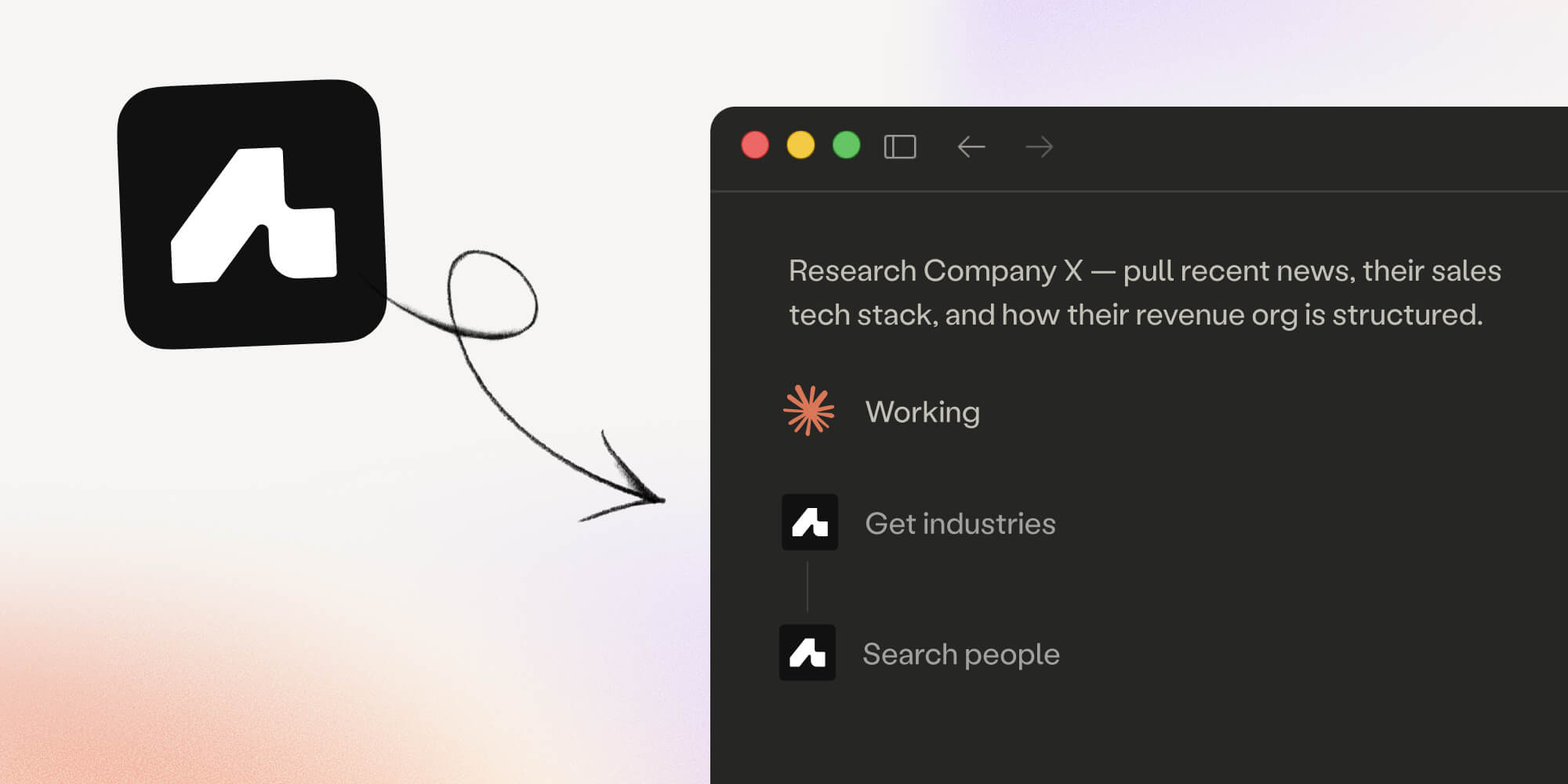
Duo's Research agent handles this autonomously per-prospect.
2. Per-channel message generation
A good email is not a good LinkedIn message. AI generates channel-appropriate content:
- Emails that are structured, scannable, and have a clear CTA (75 to 150 words)
- LinkedIn messages that are conversational and question-driven (under 300 characters)
- Voice message scripts that read like natural talking points
- Call talk tracks with objection responses
- SMS that references prior context in one to two sentences
Duo Copywriter generates all of this natively.
3. Adaptive sequencing
Static sequences treat every prospect identically. AI adapts:
- A prospect who opened your email three times without replying triggers an earlier phone call.
- A prospect who accepted your LinkedIn connection gets a LinkedIn message before the next email.
- A company that just announced funding gets messaging adjusted to reference growth.
No engagement after five touches triggers deprioritization.
For a comparison of AI sequencing tools, see Best AI sales sequencing tools in 2026.
4. Timing optimization
AI analyzes engagement patterns per prospect. If someone opens emails at 7:30am and browses LinkedIn at noon, the sequence adjusts. This compounds across hundreds of prospects.
Amplemarket's Multichannel Sequences handle all channels from a single sequence builder with unified analytics and a single prospect record. The Unibox gives every rep a unified view of all conversations across all channels.
The system needs visibility across all channels to make intelligent sequencing decisions. Separate tools for email, LinkedIn, and phone create the coordination gaps that kill multi-channel motions.
Why multichannel protects your email domain
Multichannel improves deliverability. This is counterintuitive but mathematically straightforward.
Email-first with fifteen touches per prospect at 500 active prospects produces 7,500 emails. Across five mailboxes, that is 1,500 per mailbox. This is Dangerous.
Distribute across four channels: five emails, four LinkedIn, three phone, two SMS, one voicemail. Email volume drops to 2,500 total, meaning 500 per mailbox. This is Safe.
The compounding benefits:
- Lower per-mailbox volume keeps you below throttling thresholds
- Higher engagement rates improve sender reputation
- Fewer emails mean fewer spam complaint opportunities
- Higher reply rates signal inbox placement quality to ISPs.
Multichannel is a deliverability strategy, not just a revenue strategy.
Albato achieved 98% deliverability and 70%+ open rates using Amplemarket's multichannel setup with native deliverability infrastructure. Read the Albato case study.
Metrics that matter
Multichannel requires multichannel measurement. Email metrics alone give you a fraction of the picture.
Per-channel benchmarks
Email: Open rate 50%+ (warmed, personalized sequences). Reply rate 5 to 8% cold, 15%+ signal-triggered. Bounce under 3%. Spam complaints under 0.1%.
LinkedIn: Connection acceptance 25 to 40%. Message response 15 to 25%. InMail response 10 to 18%.
Phone: Connect rate 8 to 15% (signal-informed). Conversation-to-meeting 15 to 25%. Dials per connect under ten.
SMS: Response rate 20 to 35% (after prior engagement). Opt-out under 5%.
Cross-channel metrics
These matter more than any single-channel number:
- Sequence reply rate: Unique replies across all channels divided by prospects entered. Target: 12 to 20%.
- Sequence-to-meeting rate: Meetings booked divided by prospects entered. Target: 3 to 8%.
- Touches-to-meeting: Average touches before a meeting. Benchmark: 8 to 14.
- Channel-attributed pipeline: Pipeline value attributed to the full sequence, not individual channels.
- Cost per meeting by sequence type: Total cost (tools, rep time, data) divided by meetings, broken down by enterprise, mid-market, and SMB.
- Velocity: Days from sequence start to meeting booked.
Cole at Covlant, who previously used Outreach, Salesloft, Seamless.AI, and Apollo, reported "seventeen cold meetings this week, 99% show rate" after switching to a properly orchestrated multichannel approach.
That is what cross-channel measurement should point toward: meetings that actually happen, not just replies.
For small teams (two to five reps), multichannel is worth the investment even at low scale. Start with email plus LinkedIn, add phone as a third channel once the first two run smoothly. Use an integrated platform from the start.
The AI layer handles orchestration complexity. The two to four times pipeline improvement pays for itself quickly, even at small scale.
For the ROI calculation on consolidating your stack, see The real ROI of consolidating your sales stack.
Seven mistakes that kill multichannel motions
1. Treating channels as independent silos
The problem: reps send emails from one tool, LinkedIn messages from another, calls from a dialer. No coordination. The prospect gets a connection request and email on the same day, neither referencing the other.
The fix: orchestrate from a single sequence. Each touch references prior touches. "I sent you an email yesterday about..." is the connective tissue.
See how Amplemarket's Workflows automate this coordination natively.
2. Too many touches, too fast
The problem: three or four touches in one day across channels. This creates annoyance, not urgency.
The fix: space touches one to three days apart. Never hit the same prospect on more than two channels in a single day.
3. Same message on every channel
The problem: copy-pasting your email into a LinkedIn message and reading it as voicemail.
The fix: adapt to each channel's native format. Emails can be structured. LinkedIn messages must be conversational. Phone calls should be discovery, not pitch. SMS: two sentences maximum.
4. Ignoring engagement signals
The problem: running the same static sequence whether a prospect opened every email or ignored everything.
The fix: build signal-based branching. Hot engagement triggers faster follow-up on higher-touch channels. No engagement triggers pause or deprioritization.
For a deep dive on using signals to drive sequence logic, see our signal-based selling guide and Amplemarket's Intent Signals.
5. Neglecting deliverability until damage is done
The problem: scaling email without warmup, authentication, or rotation. By the time reply rates crater, domain reputation is damaged and recovery takes weeks.
The fix: set up deliverability infrastructure before sending a single cold email. Warm every mailbox. Monitor weekly. Use multichannel itself as deliverability protection.
See Amplemarket's Deliverability Booster and Domain Health Center.
6. No unified prospect view
The problem: a rep calls someone who replied on LinkedIn an hour ago, or emails someone who booked via phone. Channel fragmentation creates embarrassing collisions.
The fix: centralize all prospect activity in one place. Every touch, every reply, every engagement signal should be visible before any action is taken.
Amplemarket's Unibox does this across all channels in a single inbox.
7. Measuring channels in isolation
The problem: sales leadership sees low cold call connect rates, low email reply rates, low LinkedIn response rates and concludes outbound does not work. But the combined sequence reply rate might be 15%+.
The fix: always measure sequence-level metrics alongside channel-level metrics. The question is not "how is email performing?" but "how are our sequences performing, and what role does each channel play?"
See Amplemarket's Analytics for sequence-level measurement across all channels.
Who gets multichannel right and what they do differently
The teams producing consistent pipeline from multichannel share three traits.
1. They invert the hierarchy
LinkedIn or signal-triggered touches come first. Email follows. Phone is reserved for warm signals. This matches how B2B buyers actually build trust in 2026.
2. They consolidate tooling.
Separate tools for email, LinkedIn, and phone create coordination gaps described in mistake one above.
Outreach, for example, limits users to two mailboxes, a ceiling that forces teams to add a separate deliverability tool. Salesloft gates its dialer as a $200 per user add-on. Every additional tool adds a data silo and a potential collision point.
The teams that perform consistently use a single platform for all channels.
3. They measure sequences, not channels
The highest-performing outbound organizations track sequence-to-meeting conversion as their primary metric, then use channel-level data as diagnostic detail. This is how you discover that LinkedIn profile views on day one are the single biggest predictor of eventual reply: an insight that disappears when you measure channels in isolation.
See Amplemarket in action
“Amplemarket is like 4 tools in 1 — it’s easy to use and allows you to target the right people at the right time. I am able to work through 10x more accounts.” (Lauren Carlson, Business Development Manager, Velocity Advisory — G2, 2025)
Get your free Amplemarket trial today and discover how our AI-first sales platform can help your team book 2X more meetings while saving hours of manual work every day.
Further reading
- Best email deliverability tools in 2026 - Seven platforms scored on warmup, inbox placement, domain health, and spam checking. The go-to reference before you send a single cold email at scale.
- Best cold email software in 2026 -Nine platforms compared on deliverability infrastructure, AI personalization, and total cost of ownership. Useful if your motion is email-first or you are evaluating standalone cold email tools.
- Best AI sales sequencing tools in 2026 - Ten platforms compared on signal-triggered entry, AI messaging, multichannel orchestration, and deliverability. Explains why the gap between static cadences and adaptive AI sequences is the difference between 3% and 15%+ reply rates.
- Best multichannel sales outreach tools in 2026 - Which platforms natively automate which channels versus relying on manual tasks or browser extensions. Covers compliance, stack cost, and LinkedIn automation risk across ten tools.
- Best AI sales engagement platforms in 2026 - The broadest comparison in the series: ten platforms across 231 features covering AI, data, signals, channels, deliverability, and total cost. Useful for understanding where multichannel fits within a full stack evaluation.
- Signal-based selling: the complete guide - What signal-based selling is, why timing beats fit in 2026, and how to build a prospecting motion around buying signals rather than static lists.
- Sales platform innovation report 2026 - A category-level view of where the market is heading and why the email-cadence-plus-dialer model is being replaced by AI-first platforms that handle the full outbound workflow.