
Published
Edited
You are managing four, five, maybe six separate tools just to run outbound.
One for data. One for sequences. One for social. One for deliverability. Another for intent signals.
They do not talk to each other, and your reps are losing hours to workflow friction that has nothing to do with selling.
That is what this guide is for.
What is Salesloft?
Salesloft is a sales engagement and revenue orchestration platform founded in 2011. It provides cadence management, conversation intelligence, deal management, and CRM integrations for B2B sales teams.
In December 2025, Salesloft completed a merger with Clari, adding AI-powered revenue forecasting and pipeline intelligence.
The combined company serves over 5,000 organizations globally including Google, IBM, and Shopify, and holds a G2 rating of 4.5 out of 5 across 5,502+ reviews.
Does Salesloft have B2B contact data?
No. Salesloft has zero native B2B contact data.
No contact database, no email finding, no phone numbers, no firmographics, no technographics, no data enrichment. Every Salesloft team must purchase a separate data provider, typically ZoomInfo ($15,000 to $45,000 per year), Cognism, or Apollo.
We scored both platforms across 77 sub-features in 10 categories using a 0 to 3 scale.
Every score is documented and reproducible. Here is what we found.
Amplemarket scored 221 out of 231 in our feature evaluation (95.7%), compared to Salesloft's 92 out of 231 (39.8%). Amplemarket wins 9 of 10 categories. The one category Salesloft wins, revenue intelligence, is significant, and this guide is honest about why.
Rated 4.6 out of 5 from 571+ reviews on G2, Amplemarket's Duo Copilot operates three specialized agents, Signal, Research, and Sequence, that detect buying signals, research prospects, and generate personalized multichannel sequences automatically. The rep reviews, approves, and the sequence runs.
Salesloft brings genuine strengths in deal management and revenue forecasting, capabilities strengthened by the Clari merger.
But running a Salesloft-centered outbound stack in 2026 means purchasing four to six additional tools at a total cost of $5,600 to $8,800 per user per year, and it still cannot match the AI capabilities, contact-level intent signals, or deliverability infrastructure of a consolidated platform.
Feature comparison: the full picture
The table below scores both platforms across 77 sub-features organized into 10 categories.
Each sub-feature is rated on a 0 to 3 scale (0 = not available, 1 = basic, 2 = good, 3 = best-in-class).
Amplemarket wins 9 of 10 categories.
The one category Salesloft wins, revenue intelligence, deserves a closer look, and we cover it honestly below.
For the complete methodology used across all our comparisons, see best AI sales engagement platforms in 2026.
Data and lead generation: 29 to zero
This is the most striking gap in the entire comparison.
Salesloft has zero native B2B contact data. Not a small database. Literally none. No contact database, no email finding, no phone numbers, no firmographics, no technographics, no data enrichment.
Every Salesloft team must purchase a separate data provider.
The cost of this gap is not just financial.
It creates a broken workflow: search for leads in ZoomInfo, export a CSV, import into Salesloft, wait for sync, then build cadences.
The data quality from separate providers is often poor. One enterprise customer replacing Salesloft documented 15% wrong number rates and 30% email bounce rates from their data vendor.
Amplemarket includes 200M+ verified profiles with 70M+ weekly updates and under 3% bounce rates natively.
Reps discover prospects, enrich data, build sequences, and launch campaigns without leaving the platform.
For a deeper look at how data providers compare, see best AI B2B data providers in 2026.
AI and automation: 26 agents vs three that work together
Salesloft markets "26 AI agents" aggressively.
The reality is that Conductor AI assists within rigid boundaries.
These agents prioritize tasks, draft basic emails, and provide account summaries.
They do not create autonomously. There is no AI sequence generation, no AI voice cloning, no AI reply handling, no AI inbox management, and no feedback-driven learning.
Amplemarket's Duo Copilot operates three specialized agents, Signal, Research, and Sequence, that work together.
Duo detects a champion job change, researches the new company, identifies the right messaging angle, and creates a personalized multichannel sequence automatically. The rep reviews, approves, and the sequence runs.
Salesloft's AI tells reps what to do next. Duo does the work.
Since launching, Duo has generated over 1.1 million hot leads (and counting) for customers.
Jackson Reimers, Director of New Enterprise Business at DataStax, experienced this firsthand:
"With Amplemarket, all that busywork is gone. Now, we're either prospecting inside Amplemarket and dropping leads straight into sequences, or pulling leads from Salesforce and sequencing them in seconds."
In under 5 months, DataStax generated 65+ enterprise opportunities with 3x higher replies on Duo leads compared to traditional methods.
Deliverability: 21 to zero
Salesloft has zero deliverability tools. No email warmup. No inbox placement testing.
No domain health monitoring. No spam checker. No mailbox selection AI. No dedicated IP pools.
G2 reviewers describe Salesloft as one of the weakest platforms for modern email deliverability.
Mailbox rotation struggles with bulk sender rules, and daily email caps throttle outreach.
Amplemarket provides a complete deliverability suite included in every plan: automated warmup, inbox placement testing, domain health monitoring, proactive spam checking, and AI-driven mailbox selection.
Chandler Minaldi, Head of Growth at 5th Line, experienced the difference:
"Deliverability was a huge issue for us. We were just not getting anywhere. Moving everything under Amplemarket — including email warm-up — was a game-changer."
Since implementing Amplemarket, 5th Line maintains bounce rates under 2.5% across all leads.
For a detailed breakdown of how deliverability tools compare across the category, see best email deliverability tools in 2026.
Social prospecting: 18 to 2
Salesloft approaches social through a Sales Navigator integration, which requires the Advanced Plus plan.
The functionality includes adding connection requests and messages as steps in cadences.
But execution is manual. When a social task appears, reps must open the social platform, find the prospect, and complete the action themselves.
Amplemarket takes a different approach to social prospecting, giving reps the tools to engage prospects across social channels at scale.
Multichannel engagement: 34 to 18
Salesloft's cadence engine is its foundation, and it works. Email sequences, phone tasks, templates, A/B testing, and analytics are well-implemented after a decade of enterprise deployment.
But the channel coverage is limited. Social steps are manual reminders. There is no WhatsApp or iMessage. No AI voice messages. No parallel dialing. No conditional branching based on prospect behavior. Mailbox rotation is constrained.
Amplemarket supports seven channels natively: email, phone (with parallel dialing), social selling, SMS, WhatsApp, iMessage, and AI-generated voice messages.
Conditional sequences adapt based on prospect behavior, so outreach adjusts in real time rather than following a rigid path.
Duo Copywriter crafts intent-based messages. Duo Inbox auto-generates contextual replies to objections. Duo Voice creates AI voice messages that sound natural and personal.
Buying intent and signals: 30 to 4
Salesloft scores 4 out of 30 on buying intent, limited to basic CRM activity signals.
There is no contact-level intent detection, no job change tracking, no website visitor identification, no social engagement monitoring, and no competitive intelligence signals.
Amplemarket scores 30 out of 30 with 100+ signal types at both contact and account level. This includes job change alerts, competitive intelligence, website visits, social engagement, funding events, hiring surges, and technology changes.
The difference is architectural. Salesloft tells you how to reach out. Amplemarket tells you who to reach out to and why, right now.
Where Salesloft genuinely leads: revenue intelligence
Salesloft scores 20 out of 24 on Revenue Intelligence versus Amplemarket's 17 out of 24. This is a real advantage worth being direct about.
Conversation intelligence: Salesloft's Conversations module provides call recording, transcription, AI-powered sentiment analysis, keyword tagging, and coaching insights. This is a mature capability.
Amplemarket now includes conversation intelligence with call recording, transcription, and AI-powered insights, but Salesloft's implementation is more established.
Deal management: The Deals module offers AI-powered deal analysis with MEDDPICC, SPIN, and BANT framework support. For enterprise sales methodologies, this is valuable. Amplemarket does not offer deal management.
Revenue forecasting: Enhanced by the December 2025 Clari merger, Salesloft's forecast agent predicts meet, beat, or miss targets with AI-powered prediction. Clari brings $10 trillion in revenue under management. Amplemarket does not offer revenue forecasting.
Deep Salesforce integration: Real-time bi-directional sync built over ten years of enterprise deployment.
These are not trivial advantages. For organizations where call coaching, deal management, and revenue forecasting are central to their workflow, Salesloft's Revenue Intelligence module delivers real value.
The redirect, however, is important. Conversation intelligence and forecasting analyze existing pipeline.
They do not create it.
If your data provider gives you 15 to 30% bounce rates, your social steps are manual, and you have zero deliverability tools, the pipeline feeding those conversations is smaller than it should be. Most teams need better top-of-funnel before they can optimize the bottom.
For context on how the Clari merger affects this landscape, see the sales platform innovation report.
Who each platform is built for
Salesloft: built for revenue teams focused on deal management
With the Clari merger, Salesloft is evolving into a revenue intelligence platform. Its strongest capabilities now center on deal management, conversation intelligence, and forecasting, serving AEs and sales leaders more than frontline SDR prospecting.
Like Outreach, it has no native data, no deliverability, and no social automation.
Amplemarket: the all-in-one Salesloft alternative built for sellers and ops
Amplemarket serves the full revenue team. SDRs prospect and book meetings. AEs run targeted outreach. RevOps configures the platform.
All on one login with data, AI, signals, social automation, and deliverability included.
Alexandra Giraldo, Global SDR Manager at Cabify, puts it simply:
"I lead a global team of SDRs that was using 7 different tools to complete the full top funnel cycle, now we're just using Amplemarket to do it."
What this means for your team
If your primary need is deal management, forecasting, and conversation intelligence for AEs, Salesloft with Clari is heading in that direction.
If your SDRs need a prospecting platform that includes everything from data to deliverability, while your managers get analytics and your ops team gets configurability, Amplemarket is the all-in-one alternative.
Pricing comparison: total cost of ownership
Salesloft does not publish pricing. All plans require annual contracts with custom quotes.
Salesloft pricing (engagement only)
Amplemarket pricing (everything included)
All plans include data, AI, signals, social automation, deliverability, and multichannel engagement. No add-ons. No implementation fees.
For a transparent breakdown of what each plan includes, see Amplemarket pricing in 2026.
Real-world scenario: 25-user mid-market team
The savings compound at enterprise scale. A 50-user team could save $28,000 to $295,000 annually by consolidating from a Salesloft-centered stack to Amplemarket.
As Jackson Reimers at DataStax put it after replacing ZoomInfo, Salesloft, Lusha, and 11x with Amplemarket:
"It is not more expensive if you can drop multiple tools. Amplemarket definitely saved us money."
What real users say: G2 and Reddit
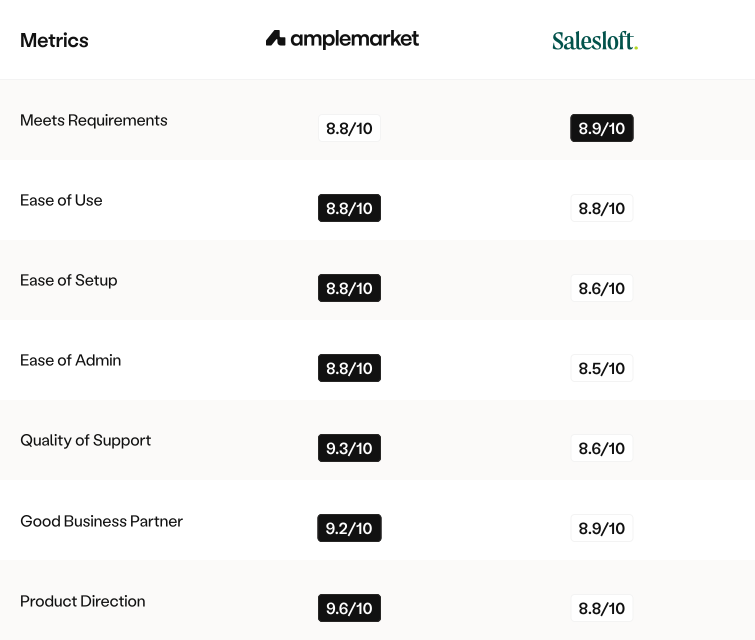
Salesloft: G2 rating 4.5 out of 5 (5,502+ reviews)
What users praise:
Users consistently highlight Salesloft's cadencing features, template management, and list import capabilities. Call recording and coaching insights are valued for manager oversight. The interface is described as easy to navigate with good analytics access.
What users criticize:
Performance issues surface frequently. Reviewers describe slow load times, dropped calls, and delayed sends that add friction to daily workflows.
Email deliverability is the most common complaint among power users. Multiple reviewers describe Salesloft as weak on modern email deliverability, citing no native warmup, no spam testing, and no inbox monitoring.
Social limitations are another recurring theme. Social steps in cadences are manual reminders, not automation. Reps must click through each social task individually.
Aggressive renewals appear in multiple reviews. Users describe unexpected pressure to expand licenses and warnings of price increases mid-contract. One reviewer reported being billed after requesting non-renewal.
Amplemarket: G2 rating 4.6 out of 5 (571+ reviews)
Katie Penner, Head of Sender Relations at Sendoso:
"We use AI to make space for what matters: meaningful, human engagement. That's what sets us apart."
Kyle Rasmussen at Chat Metrics describes the productivity shift:
"Amplemarket is helping me do the work of what would probably take 6 reps on a platform like Outreach/SalesLoft."
Cole McCarthy at Covlant switched from multiple legacy tools:
"I've used the likes of Outreach, Salesloft, Seamless, and Apollo in the past, but only Amplemarket had great quality AI features and really streamlined integration."
Within his first month, he booked 35 meetings using Amplemarket. Read the full case study.
What competitors' own users say
Jesse Shalev, Senior SDR at Waterfall Security (G2 verified active user):
"Switching to Amplemarket from Salesloft has been beneficial because Amplemarket offers more for a lower cost."
For more customer stories, visit the Amplemarket wall of love.
A note on security history
In August 2025, Salesloft's Drift chatbot integration was involved in a supply chain security incident that affected over 700 organizations.
The breach was attributed to a threat actor tracked as UNC6395 and was contained by September 2025.
FINRA issued a cybersecurity alert related to the incident. Salesloft maintains SOC 2 Type II, ISO 27001, and ISO 27701 certifications.
For enterprise buyers with strict security review processes, this is worth evaluating within your own risk framework.
What you would still need to buy: stack gap analysis
With Salesloft, you still need:
Even after spending $4,844 to $7,096 per user per year on supplementary tools, you still cannot replicate contact-level intent signals, AI voice cloning, AI reply handling, or a unified platform without data silos.
With Amplemarket, you still need:
Amplemarket's gaps are in downstream revenue operations. Salesloft's gaps are in the entire top-of-funnel: data, signals, deliverability, social, and AI.
The question is which gaps are harder to live with.
Verdict
Salesloft remains a strong sales engagement platform with legitimate advantages in conversation intelligence, deal management, and revenue forecasting. The Clari merger strengthens this position.
For organizations that already have a data provider they are satisfied with, a social automation tool, a deliverability suite, and intent signal coverage, Salesloft's cadence engine and revenue intelligence are competitive.
But that conditional, "if you already have all of those other tools," is why teams are looking for Salesloft alternatives in the first place.
Running a Salesloft-centered stack in 2026 means purchasing and managing four to six separate tools at a total cost of $5,600 to $8,800 per user per year.
The data comes from a different vendor, often with 15 to 30% bounce rates. Social steps are manual reminders. There is no email warmup, no inbox placement testing, no domain health monitoring.
Amplemarket consolidates all of these gaps into a single platform at $2,880 to $3,960 per user with annual billing.
That is 35 to 59% less than the Salesloft stack for dramatically more capability and security.
Choose Salesloft if you are an enterprise team prioritizing deal management and revenue intelligence, if conversation intelligence, forecasting, and MEDDPICC deal analysis are central to your workflow, and you already have a data provider, deliverability suite, and social tool you are satisfied with.
Choose Amplemarket if you want sellers and ops on one complete prospecting-to-meeting platform, if your SDRs need data, AI, signals, social automation, and deliverability in a single product while your managers get analytics and your ops team gets configurability.
For teams evaluating Salesloft alternatives in 2026, the comparison increasingly favors the platform approach. One contract. One login. One vendor.
Start your free 14-day trial and see the difference.
Further reading
- For the full cost breakdown including the dialer, data, and deliverability add-ons, see how much Salesloft really costs.
- Best AI B2B data providers in 2026: How Salesloft's data gap compares to 8 dedicated data platforms.
- Best AI sales engagement platforms in 2026: 10 tools tested across 231 features including Salesloft.
- Best email deliverability tools in 2026: 21-point deliverability framework with detailed scoring.
- The sales platform innovation report: who is actually shipping in 2026: Release cadence, AI depth, and channel investment across 9 platforms.
- AI in sales 2026: what actually works and what is overhyped: Evidence-based assessment of AI capabilities across 9 platforms.
- Amplemarket's Duo Copilot: Product overview of the AI copilot layer.
.jpg)
.jpg)