Published
I have spent the last 10 years working in sales across multiple roles and growth stages. I started out as a BDR, moved into closing as an AE, then into team leadership, and eventually into Head of Sales. Roles where I was responsible for building outbound motions from the ground up.
Across that time, I have prepared for more Q1 launches than I can count. I have worked through years of aggressive growth, tight budgets, changing buyer behaviour, and constant shifts in how teams prospect and sell.
One thing has stayed consistent. The teams that win Q1 are not the ones scrambling in January. They are the ones who enter the year with clarity, focus, and a system that supports execution from day one.
This blog is based on what I have seen work in practice. It is how I think about kicking off Q1 strong in 2026 and building early momentum that lasts.
The first few weeks of the year set the tone for everything that follows.
Some teams come out flying. Others spend January recalibrating, chasing cold pipeline, and fixing problems that should have been addressed earlier.
The difference is rarely effort. It is preparation and intent.
If you’re asking “How should my sales team prepare for Q1 in 2026?” , this is the system I use to ensure we start fast, stay focused, and build momentum that compounds throughout the quarter.
Step 1: Start Q1 with a clean, honest pipeline
Goal: Eliminate false optimism and focus effort where deals can actually move.
One of the biggest mistakes teams make at the start of the year is carrying an inflated pipeline forward.
Deals that were never real are still sitting open. Forecasts look healthy on paper but collapse under scrutiny.
The first thing I do in Q1 is force clarity.
I split the pipeline into 3 categories
- Deals that are actively moving and have clear next steps
- Deals that need requalification early in the quarter
- Deals that should be closed out or deprioritised
This reset matters. A clean pipeline creates confidence. A bloated one creates false optimism and wasted effort.
Why this matters in Q1
- Improves forecast accuracy early
- Prevents wasted outbound effort
- Creates focus from day one
Step 2: Shift from activity to signal-based outbound
Goal: Make outbound relevant during a period of budget resets and prioritisation.
Early Q1 is not the time for generic outbound.
Buyers are resetting priorities, budgets, and tools. Attention is selective. Relevance matters more than volume.
Instead of measuring success by how much outreach goes out, I focus teams on timing and signal.
There are 4 triggers we prioritise in Q1
- Budget and planning signals
Teams are reassessing spend, ROI, and tooling as the year begins. - Leadership changes
New Heads of Sales, CROs, RevOps, or Finance leaders often bring new direction early in the year. - Tech stack changes
CRM migrations or new sales tooling usually indicate internal change and opportunity. - Growth or contraction signals
Hiring, restructuring, or fundraising all influence buying behaviour and urgency.
Signal-based outbound performs better in Q1 because it reflects real change inside an account, not assumptions.
Tools like Amplemarket play a key role here by helping surface these signals quickly so outreach is driven by reality, not static lists.
Step 3: Redefine the goal of early Q1 outbound
Goal: Earn relevance before asking for time.
The goal of outbound at the start of the year should not be to book meetings at any cost.
The real goal is relevance.
Prospects should immediately understand why you are reaching out and why the conversation is worth having now.
That means outreach that
- References real context
- Speaks to current priorities
- Feels timely rather than automated
Amplemarket enables this by making it easier to personalise outreach based on live signals instead of static lists.
When timing is right, messages do not need to be long to be effective.
Step 4: Build a focused Q1 pipeline early
Goal: Create momentum in the first weeks instead of scrambling later.
Strong Q1s are built in the opening weeks, not the final ones.
The teams that miss targets rarely fail because of effort. They fail because they spend the first half of the quarter reacting: chasing gaps, rebuilding pipeline, and changing priorities mid-stream.
I push teams to be deliberate early rather than reactive later.
In practice, this looks like
- Clearly defining Q1 priority accounts. Everyone should know exactly which accounts matter this quarter and why.
- Attaching a reason to every outbound touch. Every message should have a clear trigger, budget resets, leadership changes, tooling shifts, or growth signals, not just a name on a list.
- Running shorter, more thoughtful sequences. Fewer steps, tighter messaging, and relevance over persistence.
- Reviewing results weekly and adjusting fast. Early feedback loops matter more than perfect planning.
When teams do this well, pipeline builds steadily instead of spiking late under pressure.
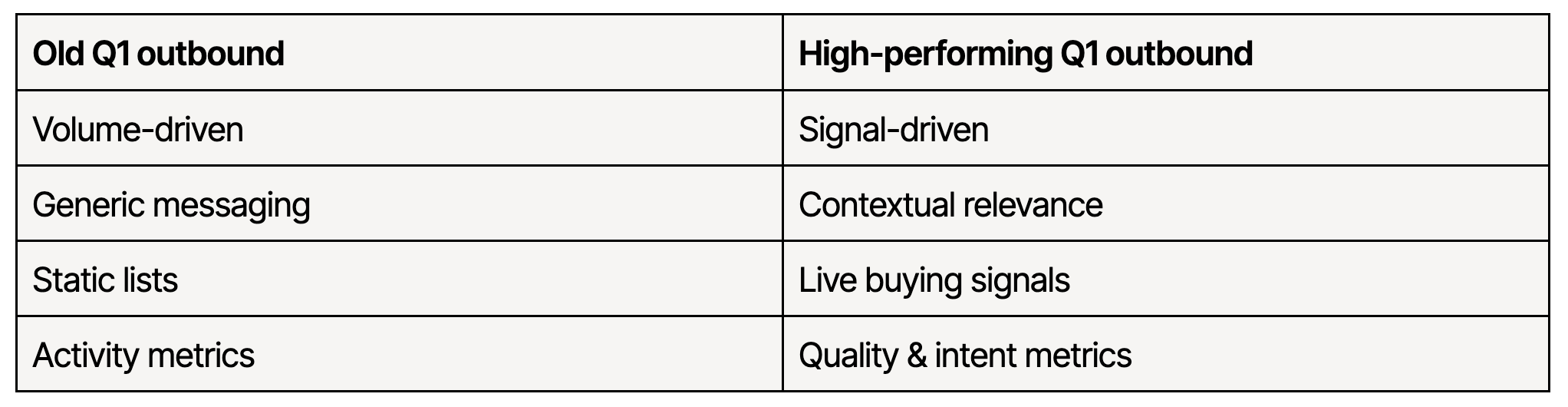
Tools like Amplemarket support this approach by helping teams prioritize the right accounts, surface real buying signals, and refine targeting without slowing execution.
Building a focused pipeline early gives teams room to execute calmly, learn quickly, and stay in control as Q1 unfolds.
Step 5: Coach for quality and consistency
Goal: Lock in the habits that carry through the year.
Q1 is where habits form.
For BDRs, the focus should be on learning which signals convert and which messages get responses.
For outbound AEs, the focus should be pipeline quality and progression, not deal count alone.
I encourage managers to review replies, calls, and intent data regularly. The insights gained early in Q1 compound across the rest of the year.
Step 6: Align early to avoid mid-quarter chaos
Goal: Ensure teams move fast without pulling in different directions.
Misalignment is one of the biggest Q1 killers.
Targets are clear, but priorities are not. Teams move fast without moving together.
Early in the year, I align on 3 things
- Who we are prioritising this quarter
- Which signals matter most
- How success is measured beyond activity
When this alignment happens early, execution becomes calmer, faster, and more predictable.
Kicking off Q1 strong in 2026 is not about working harder.
It is about working deliberately.
Teams that focus on clean pipeline, signal-driven outbound, and relevance from day one build momentum that lasts.
When the year starts with clarity, the rest of the quarter follows.
That is how I approach Q1 planning and execution, using tools like Amplemarket not as a volume engine, but as a way to ensure the right conversations happen at the right time.
Want more sales plays like this?
I share practical guidance on:
- Designing outbound frameworks
- Running targeted campaigns that open doors with the right accounts
→ Follow me on LinkedIn (Luke Sheehy) for sales strategy insights.
If you want to go deeper:
→ An AI personalisation playbook on how to personalise sales emails at scale
→ Our blog page, where we break down proven strategies to help sales teams grow pipeline predictably
.jpg)